Why Workflow Friction is the Real Marketing Bottleneck
Think your marketing is slow because of creative production? Think again. Discover why broken workflows are the real constraints on your growth.

Marketing teams spent years operating under a collective delusion: that their biggest constraint was creative production.
If campaigns were moving slowly, the fix seemed obvious. Hire more designers, expand agency support, increase editing bandwidth, invest in tools that promise to help the team churn out assets faster.
For a long time, that logic held up. Creating high-quality marketing content genuinely required immense time, heavy cross-team coordination, and highly specialized skills.
But while marketing evolved, our workflows didn’t.
Today, even lean teams are expected to maintain an unceasing pipeline of creative across paid social, short-form video, email, landing pages, and creator partnership, not to mention the endless testing variations required for real-time optimization. We no longer operate in isolated, quarterly campaign cycles. We operate live systems.
When you scale output to that level, a new, uglier bottleneck reveals itself: The actual act of creating content is rarely the slowest part of the process.
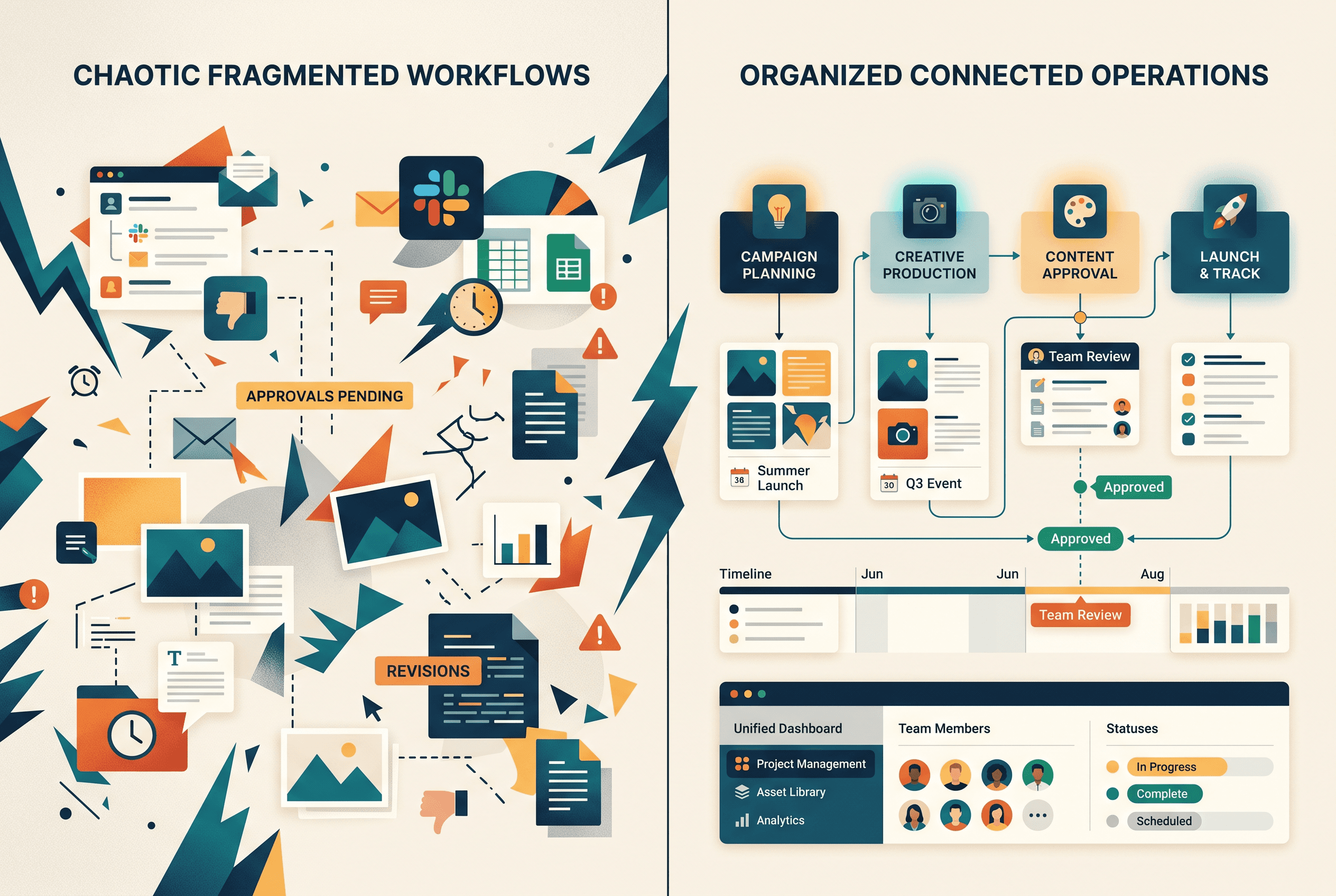
Where Momentum Goes to Die: The "Surrounding" Work
A campaign almost never stalls because a designer hits a creative wall. Momentum dies in the operational layers surrounding the work.
The initial concept gets approved in minutes. The messaging direction is aligned and the timeline looks realistic on paper. Then, the workflow begins absorbing friction from a dozen microscopic sources that seem harmless individually, but compound into total stagnation.
The Micro-Friction Checklist
Asset Delays: Updated product photography is still sitting in someone's local downloads folder.
Scope Creep: Performance marketing requests three additional placement sizes after reviewing the final targeting requirements.
Consistency Gaps: Brand consistency breaks down as teams generate large volumes of creative without shared templates or centralized campaign systems
Multi-Tool Overload: Creative teams lose time shifting between disconnected tools than actually iterating on campaign ideas.
Stakeholder Hesitation: A VP asks to "explore a few alternate headline directions" right before the scheduled launch.
Rebuild Loops: Teams repeatedly recreate campaign structures manually because reusable product profiles, visual styles, and brand-aware creative systems are not centralized operationally.
Nobody is completely blocked, but nobody is moving efficiently.
This is the inefficient nature of modern workflow friction. There is rarely a single, catastrophic failure that derails a launch. Instead, campaigns lose creative velocity through fragmented communication, version confusion, and coordination slowdowns. A process that feels manageable when you're shipping three assets a month completely fractures when you try to ship thirty.
Why Faster AI Generation Didn’t Solve the Problem
When generative AI exploded, organizations expected it to automatically cure these operational headaches. The math seemed simple: If content generation becomes instant, campaign execution becomes instant.
The reality? Generating assets faster means nothing if your internal coordination remains broken. In fact, many marketing departments watched their operational complexity skyrocket. Content volume scaled faster than internal systems could support, creating a massive digital traffic jam.
The Content Delusion | The Operational Reality |
AI produces 10x more ad variations in minutes. | Teams spend hours arguing over which variation to use. |
Tailored copy is generated instantly. | Revisions still stall waiting for manual stakeholder approval. |
Creative output increases exponentially. | Assets get lost in fragmented, disconnected tools. |
The challenge of modern marketing is no longer about producing more content. The challenge is moving content through the pipeline without it getting stuck in workflow purgatory.
Operational Traits of High-Velocity Marketing Teams

The brands winning right now aren't necessarily the ones with the largest creative budgets or the fastest AI prompts. They are the ones ruthlessly eliminating operational drag. They treat creative delivery as a connected system, prioritizing four specific traits:
1. Centralized Collaboration
High-velocity teams work out of a single, unified source of truth rather than scattered folders and chaotic chat threads. This instantly eliminates version confusion and streamlines feedback loops.
2. Structured Approval Flows
Approvals are formalized and sequential. Revision cycles have explicit boundaries so a late-stage stakeholder can't arbitrarily reset the entire creative process.
3. Systemic Brand Guardrails
Instead of relying on manual, asset-by-asset reviews to ensure brand alignment, these teams build consistency directly into their operational systems via shared component libraries and automated checks.
4. Rapid Iteration Loops
Because their coordination drag is low, these teams can take performance data and turn it into fresh creative variations in hours, not weeks.
The New Growth Constraint
As content production scales, the biggest challenge for many marketing teams is no longer generating creative.
It’s managing the workflow surrounding the creative.
Campaign assets move between generation tools, editing platforms, approval systems, shared folders, Slack threads, and project management tools that were never designed to function as a connected operational system. Once that fragmentation compounds across dozens of campaigns, creative momentum slows down quickly.
That’s one of the reasons platforms like Kreator are increasingly being built around connected creative workflows instead of isolated generation tools.
Instead of forcing teams to manage campaigns across fragmented systems, Kreator keeps generation, asset organization, reusable templates, revisions, and collaboration connected inside centralized campaign workspaces. That reduces version confusion, shortens iteration cycles, and makes it significantly easier for teams to move from idea to deployment without constantly rebuilding workflows around every new campaign.
The bottleneck has shifted. It’s no longer a production problem; it’s an architecture problem. The companies that dominate the next few years won't win on creative volume alone, they’ll win because they removed the friction between an idea and the open market.