Creative Feedback Has Been Broken for Decades. AI Finally Gives Us a Chance to Fix It.
Discover how AI-driven insights are replacing subjective creative feedback with objective data to help teams launch higher-performing ads

Marketing is obsessed with data. So why is creative feedback still a guessing game?
We’ve spent decades making campaigns more measurable and predictable. Yet, if you've worked in advertising, you know that exact meeting:
"The headline needs to be bigger."
"Can we give the image more energy?"
"Change the button color so it pops."
None of these comments are necessarily wrong. The problem is they are impossible to evaluate objectively.
Ask five experienced marketers to review the same ad, and you’ll get five different—often contradicting—opinions. Eventually, teams are forced to pick a direction, launch, and simply hope they made the right call. For years, this friction was an accepted tax on the creative process.
Then AI changed the game. Not by becoming inherently better at design than humans, but by radically multiplying the sheer volume of creative assets we have to manage.
The Bottleneck Quietly Moved
When people talk about AI in marketing, the conversation usually revolves around generation. We ask how quickly it can create images, how realistic the videos look, or if it can replace traditional design software. Those are interesting questions, but they all assume the hardest part of marketing is creating the asset. Increasingly, it isn’t.
The real challenge now begins after the asset already exists because every generated image creates another decision, every variation requires another review, and every prompt sparks another conversation about what to change next. Ironically, generating creative is becoming the easiest part of marketing. Knowing which version actually deserves your ad budget is the new bottleneck.
The teams moving the fastest aren't necessarily the ones generating the most content; they are the teams learning the fastest from every single iteration. They stop asking whether an image looks impressive and start asking questions rooted deeply in marketing psychology:
Attention: Is the product actually the first thing people notice?
Clarity: Does the headline communicate our core value proposition before a user scrolls away?
Friction: Is the background or layout introducing unnecessary cognitive load?
Action: Is the call to action visually obvious enough to create conversion momentum?
Most creative reviews aren't missing strong opinions. They are missing a consistent, objective framework.
That's Why We Built Ad Insights
Kreator's new Ad Insights tool wasn't designed to replace human creative judgment; it was built to make creative conversations productive. Instead of evaluating pure visual beauty, the platform analyzes uploaded image and video advertisements using proprietary models trained around performance psychology and conversion best practices.
When you upload an asset, the system bypasses subjective bias and evaluates the creative through a structured, data-driven lens:
Creative Category | What Ad Insights Analyzes | Performance Impact |
Visual Hierarchy | How the layout guides a viewer's eye sequentially. | Ensures the hook is seen first. |
Message Clarity | The readability and immediate comprehension of the text. | Prevents high bounce rates. |
Product Clarity | The prominence, placement, and lighting of the core product. | Builds immediate brand association. |
Brand Presence | Subtle visual distractions or rendering anomalies. | Eliminates subconscious user distrust. |
Technical Quality | Resolution, lighting, rendering quality, and visible AI artifacts. | Reduces distractions that can weaken credibility. |
CTA Next Step | The contrast, size, and positioning of the action button as well as clarity of intent. | Drives higher click-through rates. |
The Score vs. The Explanation
While teams naturally look at the overall performance rating first, we noticed an interesting pattern during our product tests. The score itself quickly became less important than the data-driven reasoning underneath it. Marketers spend far more time reading the specific behavioral feedback than debating whether an advertisement scored an 84 or a 91.
💡 The Reality of Iteration: Numerical scores tell you exactly where your creative stands. Clear, psychological explanations tell your team exactly what to edit next.
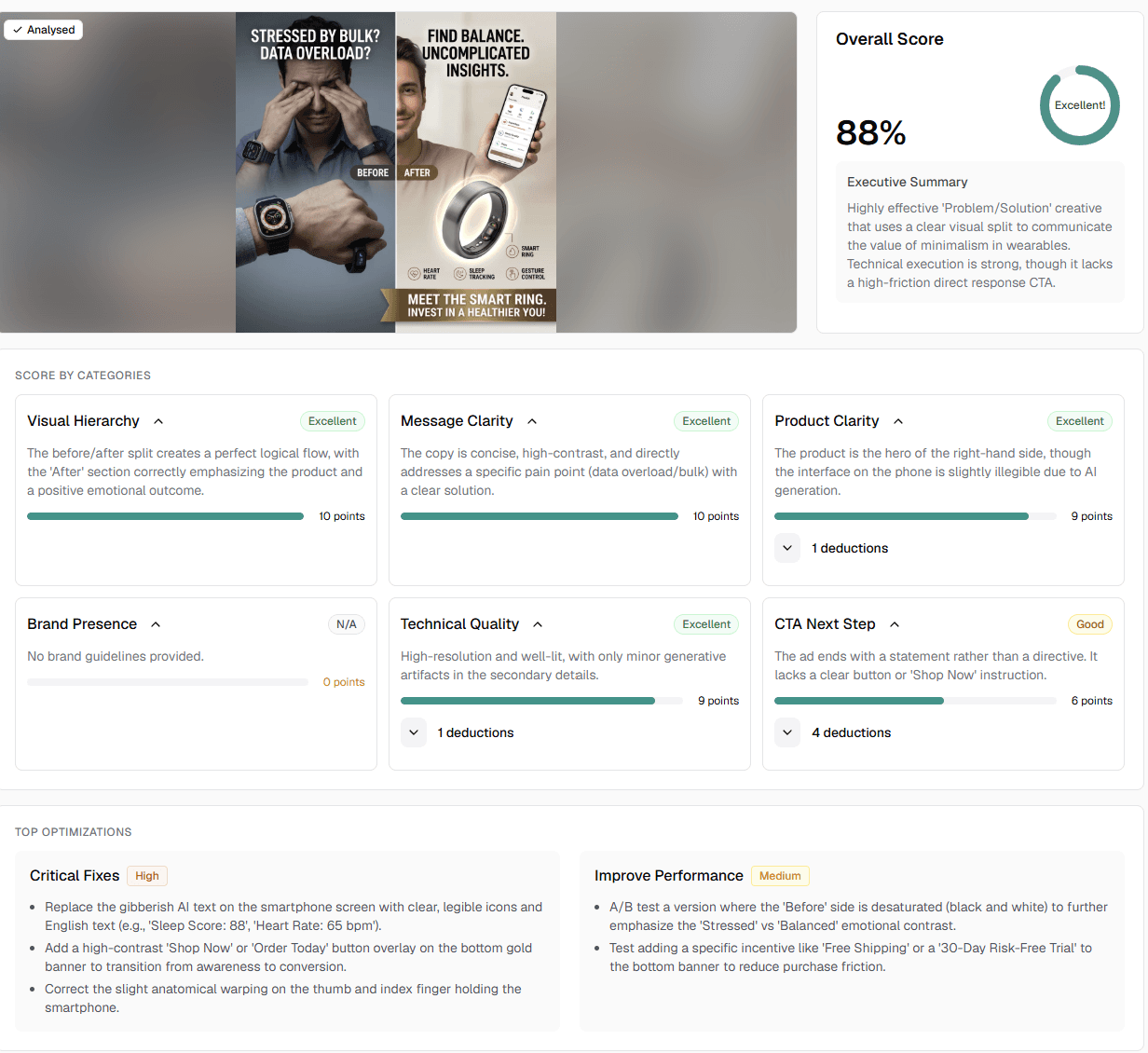
Small Details Have a Surprising Impact
During our initial testing phases, we frequently found advertisements that looked incredibly polished at first glance but contained subtle visual flaws that quietly bleed performance.
Marketing campaigns are rarely ruined by one catastrophic mistake; they are won or lost through the accumulation of tiny, unnoticed moments of friction. Ad Insights surfaces these exact details, not because they are visually interesting, but because they are psychologically critical.
Unreadable Text: Hidden blocks of distorted, AI-generated filler text on background elements (like a phone screen or a billboard) that distract the eye.
Competing Elements: Hero products fighting for attention against vibrant, unnecessary background graphics.
Anatomical Distortions: Subtle rendering errors in hands, limbs, or faces that trigger an immediate, subconscious "uncanny valley" distrust in consumers.
Creative Should Become Smarter With Every Edit
The goal of modern marketing shouldn't be to generate a flawless advertisement on your very first prompt, that is an unrealistic expectation. The real goal is to make every single version you test measurably better than the last one.
Today, Ad Insights analyzes both image and video creative in under fifteen seconds, delivering structured recommendations to marketers while they are still actively designing, rather than hours after their creative momentum has disappeared.
Beyond Generation: The Next Step of Performance Marketing
The artificial intelligence industry has spent the last few years competing fiercely to answer a single question: "What can we generate?"
We believe the next chapter of performance marketing asks a far more valuable question: "What should we improve?"
These two questions address completely different problems. One is entirely about abundance and creation; the other is about strategy and judgment. If the last year has taught us anything, it's that content creation is becoming infinitely cheap and abundant. True creative judgment, however, remains incredibly rare and valuable.
The winning marketing teams won't be the ones flooding ad networks with the highest volume of assets. They will be the ones utilizing objective frameworks to learn, iterate, and launch the smartest creative in the room.