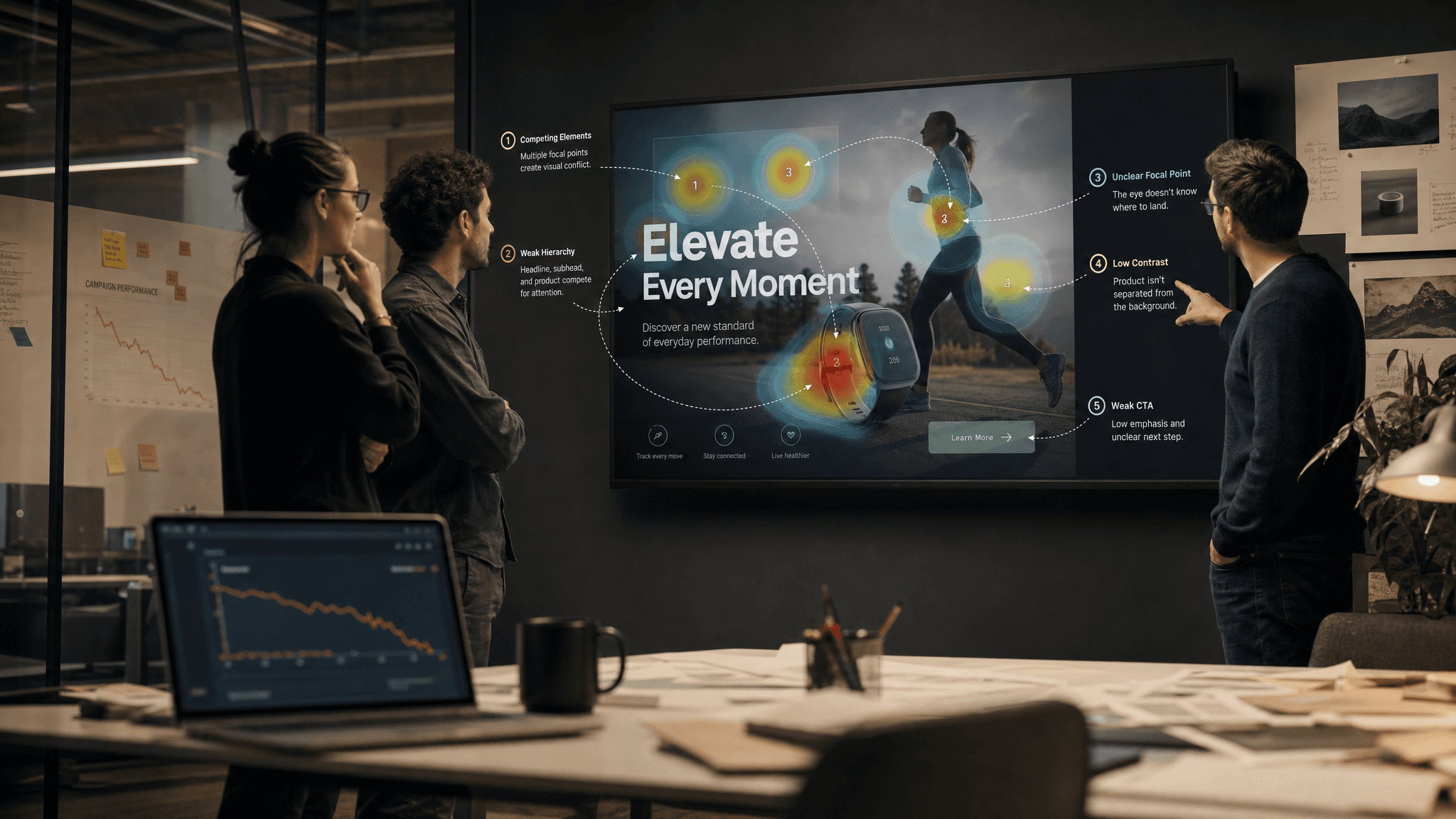
From Inspiration to Conversion: The Power of Ad Cloning
Discover how to scale your image ads and eliminate creative guesswork by reverse-engineering proven marketing frameworks with ad cloning.

Great marketers don't invent winning ads. They recognize them.
Every marketing team wants the exact same thing: ads that actually convert. But getting there can involve an exhausting amount of guesswork.
A typical campaign starts with a daunting blank canvas. Your creative team spends time and energy debating a new concept, designing layouts, and tweaking copy before the ad finally launches.
Then, the real test begins. Will it work? Sometimes you get lucky, sometimes the ad flops and the entire process starts all over again.
Thankfully, there is a much better way to operate.
The Market Is Already Showing You What Works
One of the most powerful research tools available to modern marketers isn't actually a marketing tool at all; it's the Meta Ads Library.
Every single day, brands pour millions of dollars into testing new creative. While some ads disappear after a few days, others stay live for weeks or even months. That longevity is a critical data point:
The Golden Rule: No company keeps spending real budget on an ad that isn't producing a positive return.
The Hidden Data: While you can't see a competitor's exact performance dashboard, an ad's lifespan tells you everything you need to know.
The market has already validated that specific visual framework. This doesn't mean you should copy your competitors word-for-word, but it does mean you don't have to start from zero.
Every Great Marketer Has a Swipe File
This approach isn't a new AI-era trick; it’s how great advertising has always worked. Long before digital marketing existed, copywriters tore ads out of magazines, and designers built physical inspiration boards to study broader consumer patterns.
When top performance marketers look at a winning ad, they don't just see a pretty picture. They ask specific strategic questions:
The Visual Hook: What exact imagery grabs attention in the first second?
The Layout: How is the copy balanced against the product image?
The Offer Placement: Where is the discount or value proposition positioned?
The Call to Action: How does the button design draw the eye?
Once they understand those underlying mechanics, they build something better and more tailored for their own unique audience.
The Hard Part Was Never Finding Inspiration
Finding a high-performing ad to emulate is the easy part. The real bottleneck is the manual labor required to recreate it.
Traditionally, if you wanted to build a variation of a proven image ad format, your team had to undergo a tedious creative autopsy:
The Manual Production Tax: Your designer has to study the layout grid, match the exact font styles, crop and clean up new product images, align the background colors, and rebuild the entire graphic file from scratch.
Even when you know exactly what direction you want to go, your creative team still ends up spending hours rebuilding the structural wheel. That heavy production tax slows your entire marketing engine down.
Start With a Proven Framework Instead
This operational bottleneck is exactly why we built Ad Cloning. Instead of forcing your design team to stare at a blank page or spend hours manually mimicking a layout, you can now use a high-performing ad as your foundation.
The workflow takes less than two minutes. Here is how it works:
Step 1: Source Your Inspiration
Find it: Browse the Meta Ads Library to find a competitor ad that has been running for a long time.
Snap it: Take a quick screenshot of the image ad.
Save it: Upload the screenshot to your Asset Library inside Kreator.
Step 2: Set Up Your Framework
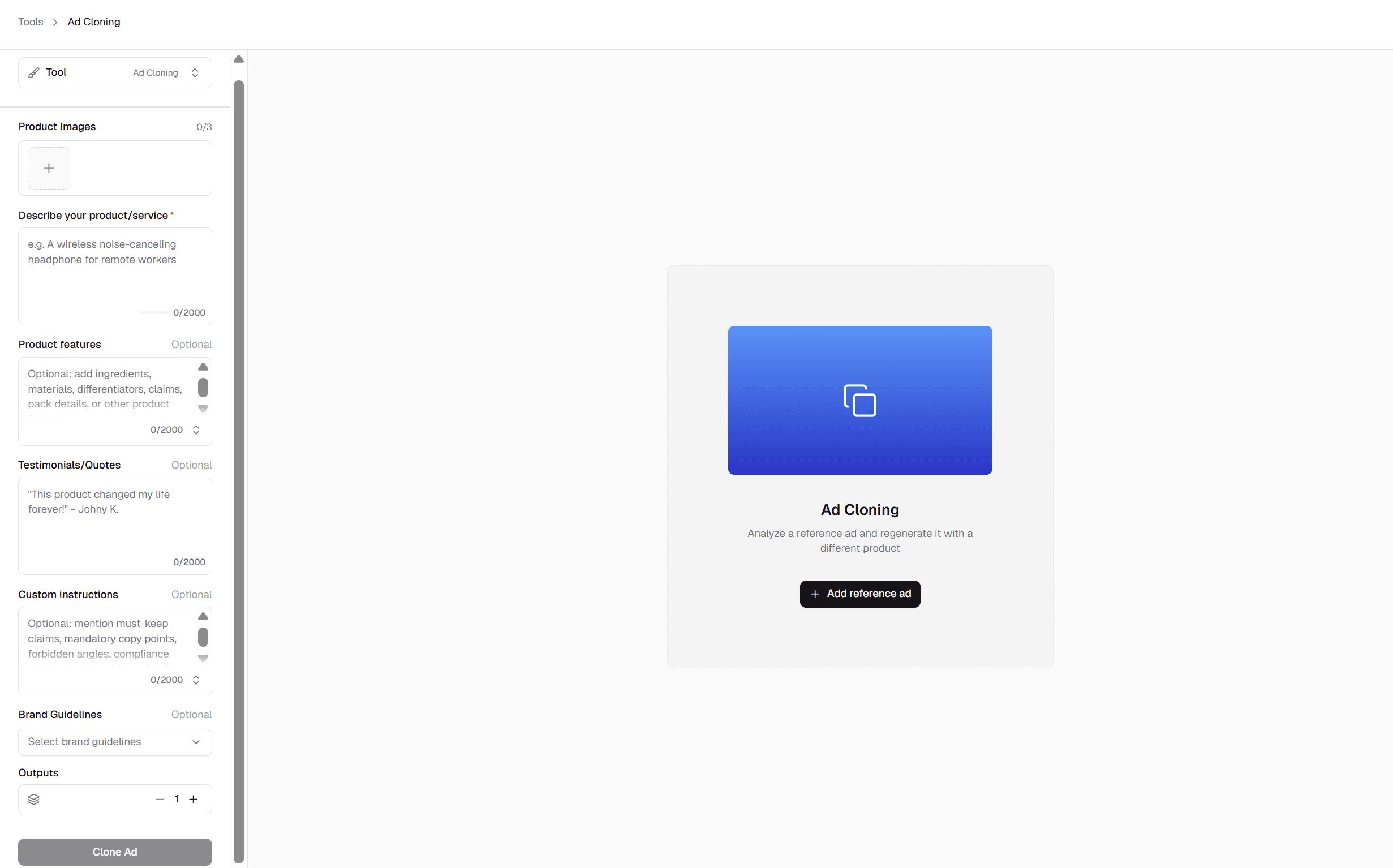
Open the tool: Launch the Ad Cloning tool within Kreator.
Select your image: Add your saved screenshot directly from your Asset Library into the tool.
Step 3: Customize the Details
On the left column, you will fill out a few simple inputs to guide the AI:
The Product: Choose an existing product from your store, and Kreator will automatically fill in all your brand details. (If it's a new product, you can type the details in manually).
Custom Instructions: Tell the AI exactly what to change (if necessary). You can request specific font styles, brand colors, or adjustments to the original layout.
Output Count: Select how many variations you want. We always suggest generating at least 2 outputs to account for different AI variations that may be generated.
Step 4: Generate
Click the "Clone Ad" button and let the AI handle the mechanical heavy lifting.
What Happens Next?
The system instantly analyzes the creative and rebuilds a production-ready template around your specific product, brand guidelines, and messaging. It maps out and replicates:
The visual layout and hierarchy
The text placement and typography style
The color balance and graphic structure
💡 Looking Ahead: While we are perfecting static image cloning today, the framework for video ad cloning is already in the works.
Instead of spending hours replicating a graphic manually, your team gets a tailored foundation in minutes. This allows them to focus their energy where it actually matters: refining the offer and perfecting the copy.
Faster Production Means More Testing
The ultimate advantage here isn't just saving time; it’s dramatically increasing your creative testing velocity.
When producing a single asset takes days of manual design work, every creative decision carries high risk. Teams overthink, over-debate, and delay launches because the upfront investment is so high.
When creating visual variations becomes frictionless, your entire experimentation culture changes:
Old Creative Workflow | New Ad Clone Workflow |
Days spent designing from scratch | Minutes spent generating frameworks |
High-risk deployment on unproven ideas | Low-risk deployment on proven structures |
Slow, defensive testing cycles | Rapid, aggressive creative scaling |
The faster you can deploy quality, validated image frameworks, the faster you discover what your audience actually responds to.
You're Not Copying. You're Learning Faster.
Some people hear the phrase "ad cloning" and immediately worry about unoriginality, but that completely misses the strategic point. The goal isn’t to mimic someone else’s brand identity; it’s to learn from what the market has already proven to be effective.
Every successful, high-performing industry relies on studying winning examples:
Athletes spend hours analyzing game film.
Filmmakers obsess over classic movie sequences.
Writers read great literature to understand pacing.
Marketers should treat creative production with the same discipline. The smartest creative teams don't ignore successful market patterns—they reverse-engineer them, adapt them, and turn them into something uniquely their own.
Start With Evidence, Not Guesswork
Blank pages rarely produce your best performance. Better starting points do. The market is already giving you a cheat sheet by showing you exactly which creative patterns are earning consumer attention and driving revenue.
You now have a system that turns those validated patterns into your next image campaign without the production friction. The most profitable ads don't always come from the wildest, unproven ideas. More often, they come from recognizing a great framework, making it your own, and getting to market before everyone else.