From Image Generation to Ad Performance
Creating images is easy. Creating ads that convert is not.

AI Made Image Creation Easier. It Did Not Make Advertising Easier.
AI has fundamentally changed how quickly marketing teams can produce visual content. What once required coordination between designers, briefs, revisions, and approvals can now happen in seconds with a simple prompt.
But while the pace of creation has accelerated, the underlying challenge of advertising has not changed. Marketing performance is still driven by iteration, not inspiration. Teams do not win because they create one great image. They win because they test multiple variations, learn from the results, and continuously refine what works.
This is where the gap becomes clear. AI has solved for speed, but it has not solved for usability.
The Two Problems Marketers Are Actually Solving
When you look closely at modern creative workflows, two problems exist at the same time.
The first is production. Marketers need to generate enough creative volume to support meaningful testing. Without variation, there is no learning, and without learning, there is no improvement. Even with AI tools, many teams still struggle to produce assets at a pace that allows them to test, fail, adjust, and try again quickly enough.
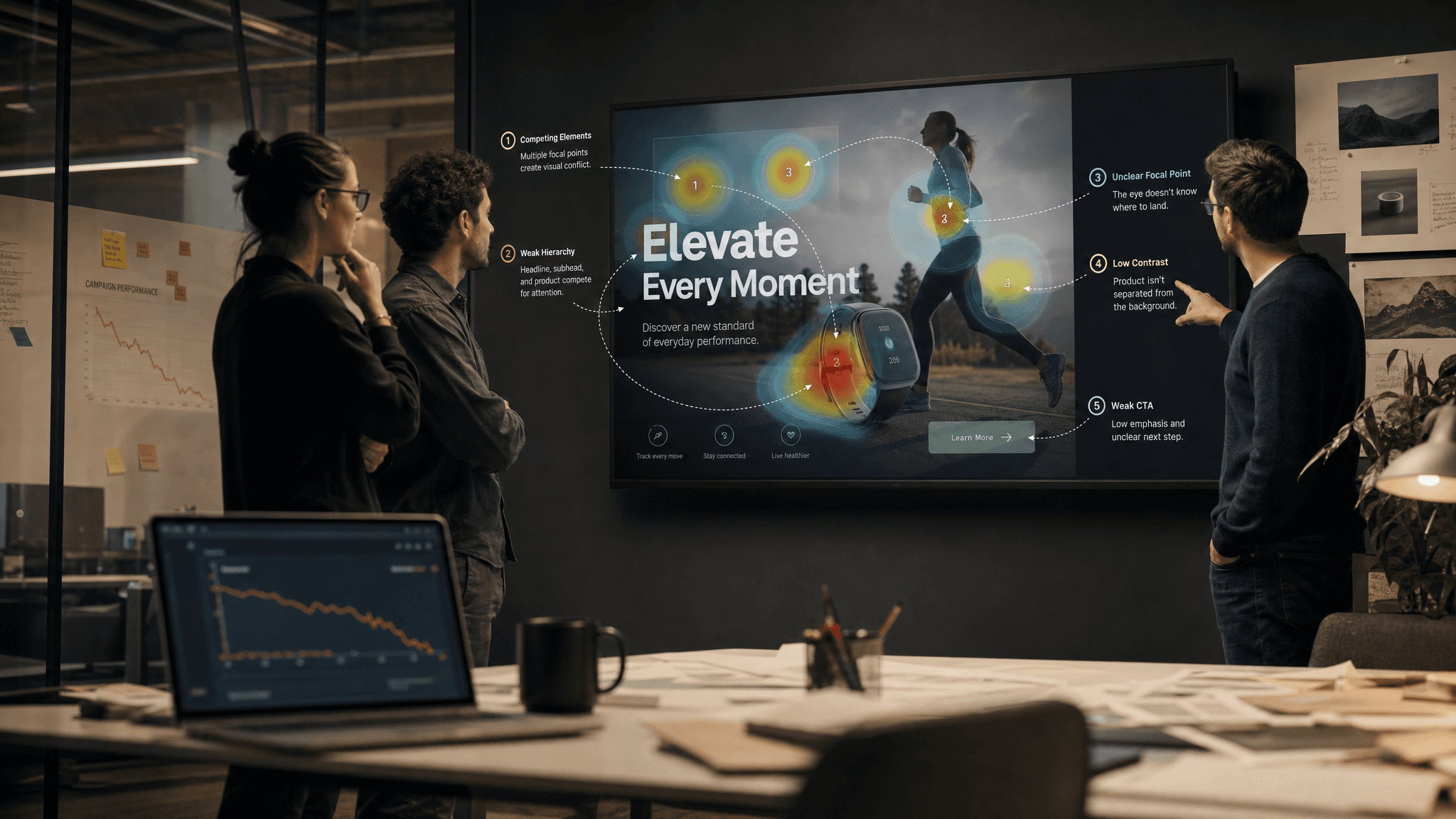
The second problem is more nuanced. Generating images does not automatically lead to generating ads that perform. A visually appealing image does not guarantee clarity, attention, or conversion. High-performing creative depends on how a product is framed, how information is structured, and how attention is guided within the visual.
This means marketers are not simply trying to create more. They are trying to create better, with a clear understanding of why certain ads work and others do not.
Why Most AI Image Tools Fall Short
Most AI image tools are built around open-ended creation. They provide flexibility, allowing users to generate almost anything from a prompt. While this is powerful in theory, it places the burden of decision-making back on the user.
Marketers are still responsible for defining the concept, structuring the visual, and translating a product into something that can function as an advertisement. The tool produces an output, but it does not provide guidance on whether that output is effective in a marketing context.
As a result, teams often generate a large number of images that require further refinement before they can be used. The workflow becomes faster at the beginning, but it slows down again before execution. The bottleneck is not removed. It is simply moved.
A Shift in Starting Point: From Images to Ads

The Image Ad Generator introduces a different way of thinking about creative production. Rather than beginning with a blank canvas, it begins with intent.
Instead of asking what kind of image should be created, the process is oriented around the question of what kind of ad is needed. This distinction may seem subtle, but it changes the role of the tool entirely.
The system is no longer generating isolated visuals. It is generating structured ad concepts that are designed to function within a campaign environment. Each output reflects a potential direction that can be tested, rather than a standalone piece of creative that requires further interpretation.
How the Image Ad Generator Works in Practice
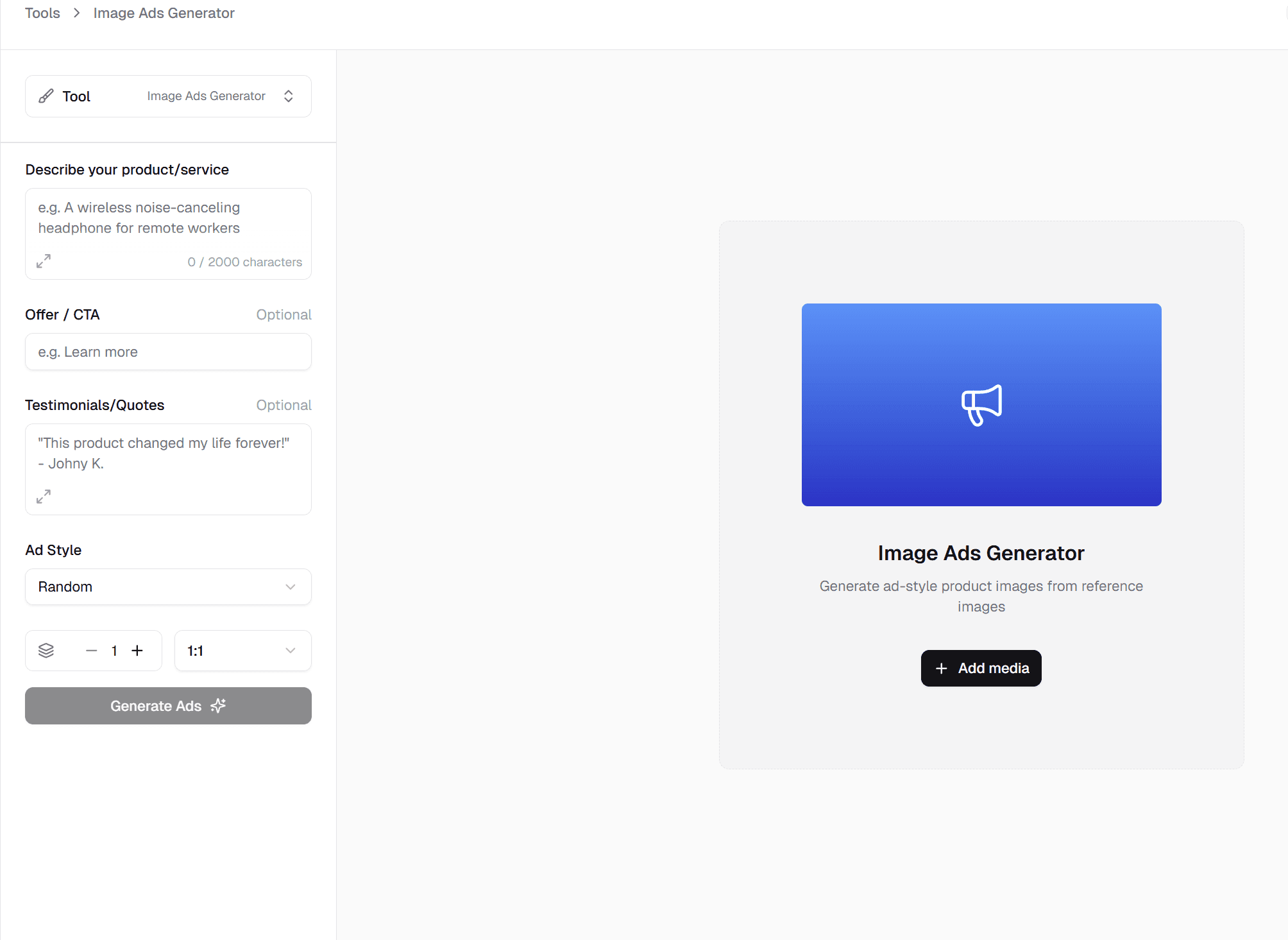
The workflow is designed to reduce both production time and decision-making effort.
It begins with a simple input. A marketer provides a product, an offer, or a campaign idea. This input does not need to be overly detailed, but it establishes the context for what the system will generate.
From there, the generator interprets that input through a marketing lens. It considers how the product should be positioned, what elements should be emphasized, and how the visual should be structured to align with common patterns seen in effective advertising.
Because the outputs are designed with advertising in mind, they already incorporate elements that support usability. The composition guides attention, the product is clearly framed, and the overall structure reflects how ads are typically consumed in real environments such as social feeds.
Once the ad is generated, the workflow becomes significantly more efficient. Instead of spending time redesigning or restructuring visuals, the marketer can focus on selecting, testing, and learning from the outputs. The emphasis shifts from production to performance.
Built by Marketers, for Marketers
One of the most important aspects of this approach is where it originates. Many AI tools are built with a focus on technical capability, optimizing for visual quality or generative flexibility.
The Image Ad Generator reflects a different priority. It is built from a marketing perspective, where the goal is not simply to produce images, but to produce assets that contribute to campaign performance.
This means the system incorporates an understanding of how ads function in practice. It accounts for the importance of variation, the role of structure in guiding attention, and the need for clarity in communicating a product or offer. These considerations are embedded into the outputs, reducing the need for manual intervention and subjective decision-making.
What Changes for Marketing Teams

When both speed and context are addressed at the same time, the workflow begins to change in a meaningful way.
Teams are able to generate enough creative to support consistent testing, while also maintaining confidence that the outputs are aligned with performance goals. The need for extensive rework is reduced, and the time between idea and execution becomes shorter.
This creates a more effective feedback loop. Marketers can move from concept to live testing more quickly, gather insights faster, and apply those learnings to future iterations without being constrained by production limitations.
From Faster Creation to Better Outcomes

AI has already proven that it can accelerate creative production. The next step is ensuring that acceleration leads to better results.
The shift is not just about creating more content. It is about creating content that is ready to perform.
By focusing on both the need for volume and the need for marketing context, the Image Ad Generator moves beyond simple image generation. It supports the full cycle of modern advertising, where speed, structure, and performance are all interconnected.
In that sense, the real value is not just in how quickly something can be created, but in how quickly it can be tested, learned from, and improved.