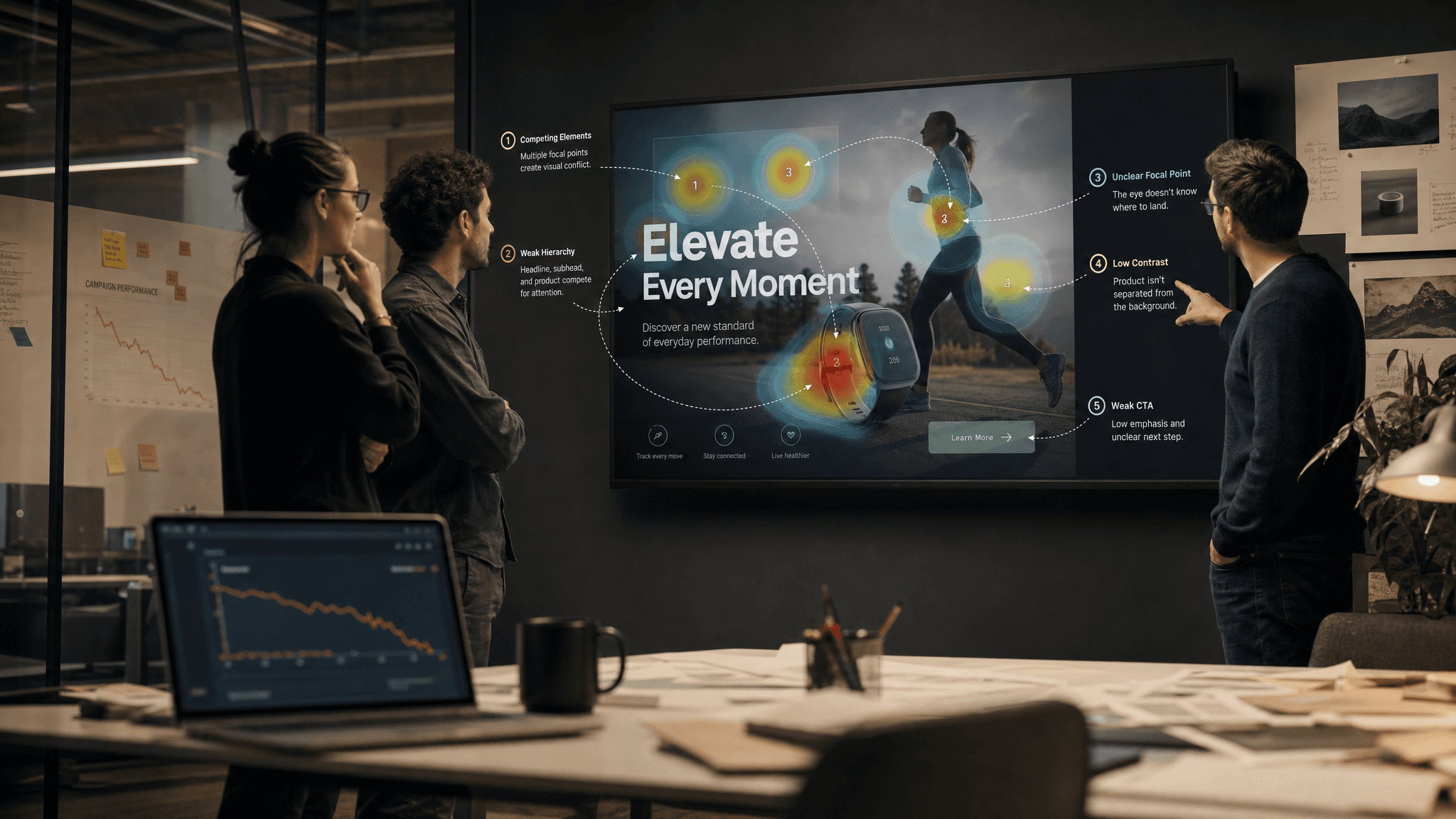
Why Good Marketing Ideas Quietly Die in the Design Queue
How lean marketing teams scale creative output, eliminate production bottlenecks, and focus on strategy without adding headcount or replacing people.

We Need More Creative Output, But We Can’t Afford Another Designer
Every growing marketing team eventually hits the same roadblock: performance marketers are asking for fresh creative, the marketing lead knows they need it, but the team’s designers are already buried under a backlog that never seems to shrink.
The standard playbook for fixing this problem has always been straightforward—add more capacity.
You hire another designer, bring in a freelancer, send extra work to an agency, or hire a dedicated video editor. For a long time, those were really the only levers you could pull. Double the creative output meant doubling the resources behind it. Creative production was directly tied to headcount, creating a clear limit on how much content a team could realistically produce relative to its budget.
That relationship, however, is starting to shift. While most conversations around AI creative focus on visual quality or high-end effects, a much bigger operational shift is happening in the background: creative output is starting to decouple from creative headcount.
Where the Bottleneck Actually Lives
To understand why this matters, consider what a typical creative queue looks like for a direct-to-consumer brand.
A designer isn’t just making core brand concepts from scratch. They are handling product shots, email graphics, landing page assets, social content, and promo banners. When an ad concept finally performs well, the natural next step is to scale it. That means:
We need a different background or product variation. Quickly change backgrounds or generate alternate versions without rebuilding the creative.
We need new product photography. Create new studio, lifestyle, or campaign imagery with Product Photoshoots.
We need a new campaign visual. Explore new concepts and creative directions with image generation.
We need this for every platform. Adapt creative into the aspect ratios required across social, ads, and other channels with Reframer.
We need narration for the campaign. Generate voiceovers and audio without another production handoff.
None of these requests are unreasonable, but they generate dozens of manual production tasks. The designer ends up spending more time resizing, exporting, and managing files than actually thinking through new concepts.
This is the exact production loop we built Kreator to solve. Instead of every variation becoming another ticket in the designer’s queue, team members can take a core concept into Kreator to generate new environments, adapt formats, or turn static assets into video without starting from scratch every time.
AI Doesn’t Eliminate Creative Roles, It Gives Small Teams Enterprise Output
There is a common, but inaccurate, assumption that introducing AI to a creative workflow is about replacing people. That misses the core shift happening inside modern marketing teams.
The real story isn’t about cutting headcount. It’s about what happens when a small, lean team can execute and manage the volume of creative that previously required a dedicated production department.
Once your team establishes a strong campaign direction—defining the visual language, setting the brand standards, and building master assets—the next challenge is immediately volume. Marketing needs assets for every channel, and performance needs variations to test.

Instead of every iteration becoming another handoff or bottleneck, platforms like Kreator acts as a shared production layer for the entire team:
Fewer handoffs: Marketers can explore variations and generate fresh campaign imagery directly, rather than waiting days for simple production tasks to complete.
Higher leverage: Designers stop acting as human file converters and spend their time directing brand quality, refining concepts, and solving high-level strategic problems.
Faster experimentation: Ideas can be tested in the real world while momentum is high, rather than getting buried in a project queue.
The work moves upstream. The focus shifts away from “how fast can we get these versions exported” toward creative direction, taste, strategic judgment, and understanding why a specific concept resonates with customers.
The Real Unlock: Handling the “Between-Campaign” Chaos
Marketing rarely moves in neat, predictable campaign cycles. The real tax on team energy comes from the non-stop flow of micro-requests that pop up every day:
An updated image for tomorrow’s promo email
Three fresh hook variations for a winning social ad
A quick visual asset reacting to a trending topic
Aspect ratio updates for a last-minute platform launch
Individually, none of these quick asks justify hiring another person. Collectively, they consume an enormous amount of time and create constant friction between team members.
You don’t expand a team just to cover a few extra visual assets on a Tuesday. Giving your current team production leverage ensures those minor requests don’t pile up or stall momentum. The hidden cost of creative output was never just salaries, it was the delay between having an idea and seeing it live.
When Execution Gets Easy, Strategy Becomes the Leverage Point
When your team is no longer limited by physical production bandwidth, the fundamental constraint on your marketing completely flips:
The Old Question | The New Question |
|---|---|
Do we have the capacity to make ten assets for this test? | Which ten concepts are actually worth running? |
Can we afford to produce a video version of this static ad? | Does this specific angle deserve a video push? |
How do we get all these file variations exported by Friday? | Why did the original campaign hit, and how do we iterate on it? |
Creative strategy doesn’t disappear when production constraints lift. In fact, judgment becomes the exact factor that determines whether all that extra capacity turns into high-performing marketing or just more noise.
A Nimbler Model for Marketing Teams
Decoupling team size from creative output changes how growing companies operate. A five-person team that needs three times as much content doesn’t need to scale into a fifteen-person organization overnight.
By building production workflows around the team you already have, you give marketers the freedom to test ideas quickly and give creative leads the space to focus on the work that actually moves the needle.
FREE TRIAL
Put Kreator to the Test and Give Your Marketing Team Creative Superpowers
Zero Risk: Start creating in seconds—no credit card required.
Explore the Platform: Test image models, video workflows, and brand systems immediately.
Built for Speed: Turn 1 core ad concept into dozens of channel-ready variations.
Start Your Free Trial
Instant setup • No credit card required • Unlimited creative leverage